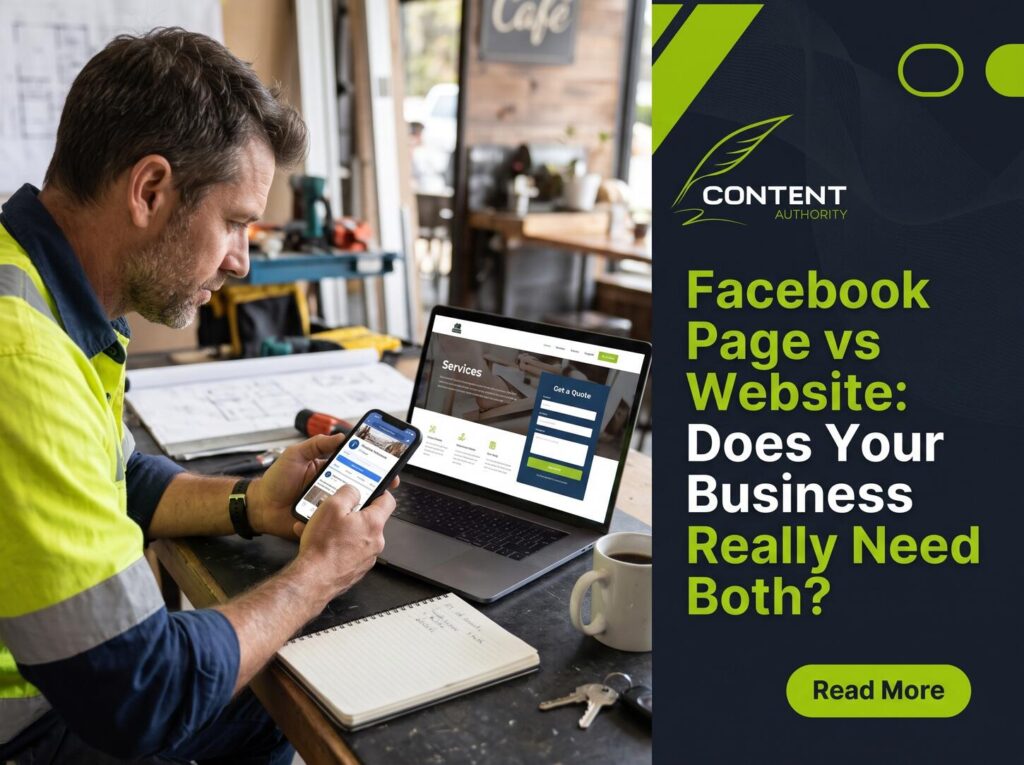
Plenty of small businesses run entirely off a Facebook page—and for a while, it works. Customers message you, mates share your posts, and the jobs keep coming in. Why pay for a website when Facebook is free?
Then one morning you can’t log in. Or your posts stop reaching anyone. Or a customer tells you they searched Google for your service and found three competitors instead of you.
That’s the moment most business owners realise a Facebook page is a great tool—but a risky foundation.
This guide breaks down what a Facebook page does well, where it falls short, and why most businesses are better off with both: a website as home base, and Facebook as the place conversations happen.
Why So Many Small Businesses Run on Facebook Alone
Let’s give Facebook its due. There are good reasons so many businesses start there.
It’s Free and Fast to Set Up
You can create a business page in an afternoon, add photos, list your services and start posting the same day. No designer, no hosting, no domain name.
Your Customers Are Already There
Facebook is still one of the most-used platforms in Australia. QUT’s 2026 Australian Media Uses Report found it’s one of only three platforms used by more than half of Australians. Whatever your business, plenty of your customers scroll it every day.
Reviews, Messages and Recommendations in One Place
Customers can message you, leave recommendations and tag you in local community groups. For businesses that live on word of mouth—tradies, cafés, salons, local services—that’s genuinely valuable.
So no, Facebook isn’t the problem. The problem is relying on it alone.
The Problem With Relying on a Facebook Page Alone
You Don’t Own Your Page
Your Facebook page lives on Meta’s platform, under Meta’s rules. If your account is hacked, suspended or disabled, you can lose access to your page—and every review, photo, message and follower on it—overnight.
This isn’t a rare edge case. The Australian Small Business and Family Enterprise Ombudsman has reported that Facebook and Instagram account for most of the small business disputes it handles with tech platforms, and hacked accounts are a large share of those cases. The Queensland Small Business Commissioner has also warned businesses about the risks of relying on a single platform.
Getting your account back can take weeks or even months—and in the meantime, customers can’t find or contact you there.
Your Posts Reach Far Fewer People Than You Think
Having 2,000 followers doesn’t mean 2,000 people see your posts. Recent benchmark studies put the average organic reach of a Facebook page post at around 1–2% of followers. Smaller pages tend to fare better, but even pages with a few thousand followers average only around 4%—so on a page with 2,000 followers, a typical post might reach about 80 people.
Feeds are crowded, and paid ads compete for the same space. Organic posts can still keep existing customers in the loop, but they’re no longer a reliable way to get in front of new ones.
Facebook Pages Rarely Show Up When People Search for Your Service
When someone needs an electrician, a physio or a dog groomer, many of them don’t start on Facebook—they search Google. And Google’s results for service searches are dominated by Google Business Profiles and websites.
Your Facebook page might appear when someone searches your business name. But for searches like “electrician near me” or “emergency plumber”, a Facebook page rarely competes with a well-built website.
Not Everyone Uses Facebook
According to the Australian Media Uses Report from QUT’s Digital Media Research Centre, 13% of Australians don’t use social media at all—and most of those non-users are aged 46 to 74. That’s a group many service businesses can’t afford to miss.
And some people who do use Facebook would rather not contact a business through it. A website reaches everyone, whether they’re on social media or not.
You Can’t Control How Your Business Is Presented
On Facebook, every business page looks roughly the same. You can’t create a dedicated page for each service, build a quote form that asks the right questions, show your service areas properly, or design a layout that guides people towards getting in touch.
Your website is the one place online where you control the whole experience.
It’s Harder to Track What’s Actually Working
A website with Google Analytics 4 and conversion tracking shows you exactly where enquiries come from—Google searches, ads, social posts or referrals. On a Facebook page, you can see post engagement, but connecting that to actual jobs is much harder.
And if you ever want to run Google Ads, you’ll usually get better results sending people to a landing page built for that ad than to a Facebook page.
What a Website Does That a Facebook Page Can’t
| Facebook page | Website | |
|---|---|---|
| Who owns it | Meta | You |
| Shows up in Google for service searches | Rarely | Yes, with good SEO |
| Organic reach | Usually a small percentage of followers per post | Anyone who finds you in search or clicks a link |
| Separate pages for each service and area | No | Yes |
| Custom quote forms and online bookings | Limited | Fully customisable |
| Detailed enquiry tracking | Limited | Full analytics and conversion tracking |
| Landing pages for ads | Limited | Built for it |
| Built on your own domain name | No | Yes |
| Content that keeps working for years | Posts disappear down the feed | Pages and articles keep bringing in traffic |
| If something goes wrong | You rely on Meta to restore access | You control the hosting, backups and domain |
A Website Strengthens Your Google Business Profile
Your Google Business Profile is often the first thing local customers see in Google Search and Maps. A profile doesn’t strictly need a website, but linking one gives customers somewhere to learn more—and gives Google more information about what you do and where you do it. That’s a big part of local SEO.
A Website Builds Credibility
When people come across a business they haven’t used before, many look for a website to check it’s legitimate and established. A professional site with clear services, real reviews and contact details answers that question in seconds. A Facebook page alone can leave people wondering.
What Facebook Does Better
To be fair, a website can’t replace everything Facebook does. Facebook is still better for:
- Community and conversation: comments, shares and replies build relationships in a way a website can’t
- Word of mouth: customers tag you in local groups and share your posts with friends
- Quick chats: Messenger is an easy way for customers to ask a fast question
- Behind-the-scenes content: photos of today’s job, new stock or your team in action
- Targeted advertising: Meta’s ads let you reach people by location, interests and behaviour
That’s why the real question isn’t Facebook or a website. It’s how to make them work together.
Why the Answer Is Usually Both
Think of your website as home base and Facebook as the place you meet people.
- Your website holds the important stuff: your services, service areas, pricing guidance, reviews, FAQs and an easy way to enquire. It’s built to be found on Google and to turn visitors into leads.
- Facebook keeps you top of mind: it’s where you share updates, show off your work and chat with customers.
- Your Google Business Profile connects the two in local search.
When they work together, each one makes the others stronger. Your Facebook posts can send people to specific service pages. Your website can showcase your best social content. And with the Meta Pixel installed on your website, you can show Facebook and Instagram ads to people who’ve already visited your site—people who already know who you are. If you use the Pixel, update your privacy policy to explain how visitor data is collected and used.
Social media still matters—it isn’t optional for small businesses anymore. It just works best with a website behind it. If you’d rather hand the posting over to someone else, our social media marketing team can keep your pages active while your website does the heavy lifting in search.
Does Your Business Need a Website? A Quick Checklist
You’ll almost certainly benefit from a website if:
- Customers search Google for the services you offer
- You offer more than one service, or work across several suburbs or regions
- You want customers to request quotes or book online
- You run ads, or plan to
- Your business would be in serious trouble if your Facebook account was locked tomorrow
- Competitors with websites are showing up above you in Google
- You’re tired of answering the same questions in Messenger over and over
If you ticked even two or three of these, a website is likely to pay its way.
When a Facebook Page Might Be Enough—For Now
We’d rather be straight with you: not every business needs a website on day one. A Facebook page alone might do the job if:
- You’re testing a new business idea before investing properly
- You run a market stall or hobby business with no plans to grow
- All your work comes from referrals and repeat customers
- You’re fully booked and not looking for new business
Even then, it’s worth securing your domain name now and protecting your Facebook account properly—so you’re ready when the time comes. A domain also lets you set up a professional email address, which looks far more credible than a free webmail account.
What a Small Business Website Should Include
A good small business website doesn’t need to be complicated. It needs to answer customers’ questions quickly and make it easy to get in touch.
Essential Pages
- Homepage: who you are, what you do, where you work and how to contact you—all clear within seconds
- Service pages: a dedicated page for each main service, so each one can rank in Google
- About page: your story, team and experience
- Contact page: phone, email, a quote or enquiry form, and your service area
- Reviews or testimonials: real feedback from real customers
- FAQs: answers to the questions customers ask you every week
Essential Features
- A mobile-friendly design that loads fast
- Click-to-call buttons on mobile
- Clear calls to action on every page
- Basic on-page SEO: page titles, meta descriptions, headings and local information
- A link to your Google Business Profile and social pages
- Analytics and conversion tracking from day one
Getting found in Google is where a website really earns its keep. Done properly, SEO turns your website into a steady source of enquiries that doesn’t depend on any algorithm favouring your posts. We’ve also covered why local SEO matters for your business if you mainly serve customers in your area.
Protecting Your Facebook Page in the Meantime
Whether or not you build a website straight away, protect the Facebook page you’ve already built:
- Turn on two-factor authentication for every admin account
- Add at least two trusted admins, so one locked account doesn’t lock you out of your page
- Set up a Meta business portfolio (formerly Business Manager) so the page belongs to the business, not to one person’s profile
- Be wary of messages claiming your page has broken the rules or will be deleted—these are a common phishing trick
- Download copies of your best photos and customer feedback regularly
Remember that your website needs protecting too—updates, backups and security monitoring are what keep it safe. The difference is that you control those safeguards.
The Australian Small Business and Family Enterprise Ombudsman publishes free guidance on using social media securely, and if you’re locked out of a business account, it can step in to escalate the dispute with Meta—though it can’t force Meta to restore access. IDCARE’s government-funded Small Business Cyber Resilience Service also offers free support to eligible small businesses with 19 or fewer full-time-equivalent employees.
Moving From Facebook-Only to a Website: Where to Start
Secure Your Domain Name
Register a domain that matches your business name—ideally a .com.au. To be eligible, you’ll need an Australian presence, such as an ABN or ACN, and the domain has to be connected to your business: an exact match, abbreviation or acronym of your business name, or closely tied to the products or services you offer. A .au domain also needs an Australian presence, but its naming rules are more flexible.
Choose a Platform You Can Grow With
Website builders are quick to start with, but many businesses outgrow them. WordPress gives you full ownership and room to expand into new services, locations and features without starting again.
Reuse What You’ve Already Built
Your Facebook page is full of useful material: photos of your work, your service descriptions and the questions customers ask most. All of it can help shape your website content.
Connect Everything
Once your site is live, add the link to your Facebook page, Instagram bio and Google Business Profile. Set up Google Analytics 4 and conversion tracking so you can see how each channel contributes.
Frequently Asked Questions
Is a Facebook Page Enough for a Small Business?
For some very small or referral-only businesses, it can be enough to start with. But if you want to be found on Google, offer several services or protect yourself against losing your account, a website is a much stronger foundation.
Can a Facebook Page Rank on Google?
Facebook pages can appear in Google when people search your business name. They rarely rank for service searches like “plumber near me”, which is where most new customers come from.
Do I Need a Website for a Google Business Profile?
No. You can create a Google Business Profile without a website. But linking a website gives customers somewhere to learn more and gives Google more context about your business.
What Happens If My Facebook Business Page Is Hacked?
You may lose access to your page, reviews and messages, and scammers may use it to run ads or contact your customers. Recovery can take a long time. Securing your account and having a website you own both reduce the damage.
Should I Stop Posting on Facebook Once I Have a Website?
No. Facebook is still valuable for community, engagement and advertising. The best results usually come from using both—with your posts sending people back to your website.
Can I Connect My Facebook Page and My Website?
Yes. Link your website from your Facebook page, add your social links to your website, and install the Meta Pixel if you want to retarget website visitors with Facebook and Instagram ads—just make sure your privacy policy covers it.
Is a Website Expensive to Maintain?
It depends on the platform and how much you change. You’ll typically pay for hosting, your domain and ongoing updates. Many businesses bundle maintenance with SEO or support plans so it’s handled for them.
Ready to Give Your Business a Home Online?
Facebook is a great place to connect with customers—but it shouldn’t be the only place your business lives. A website gives you something you own, a way to be found on Google, and a reliable path from search to enquiry.
Whether you’re in Brisbane or anywhere else in Australia, we build websites designed to be found and to turn visitors into enquiries. Find out more about our WordPress website design services, or get in touch to talk through what your business needs.
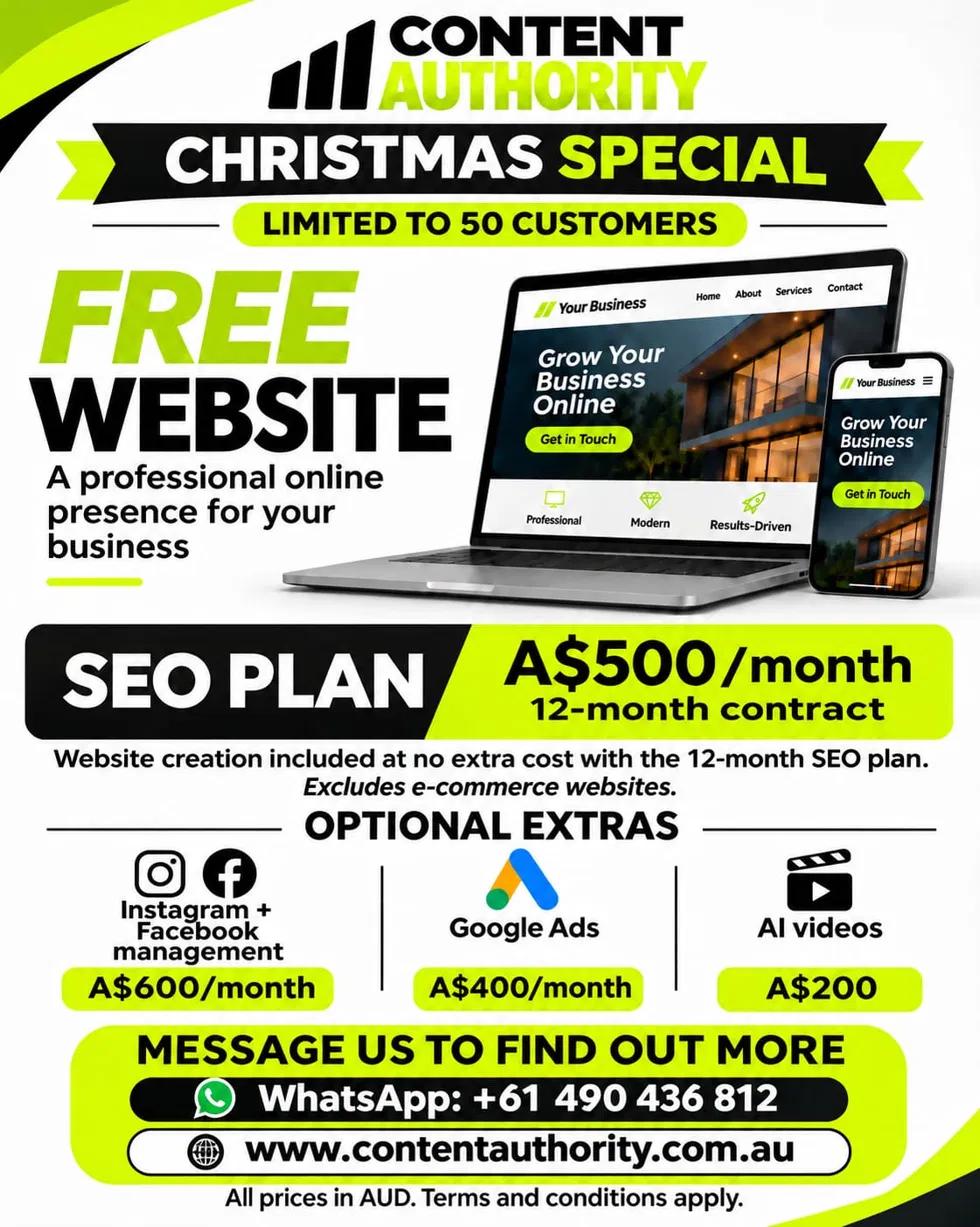
Christmas Special: Get Your Website Built at No Extra Cost
If you’ve been running your business off a Facebook page, now is the perfect time to make the move. For a limited time, we’ll build your business website at no extra cost when you sign up for our 12-month SEO plan. Spots are limited, so get in touch to find out more.
WhatsApp or call: (+61) 0490 436 812
Email: [email protected]